
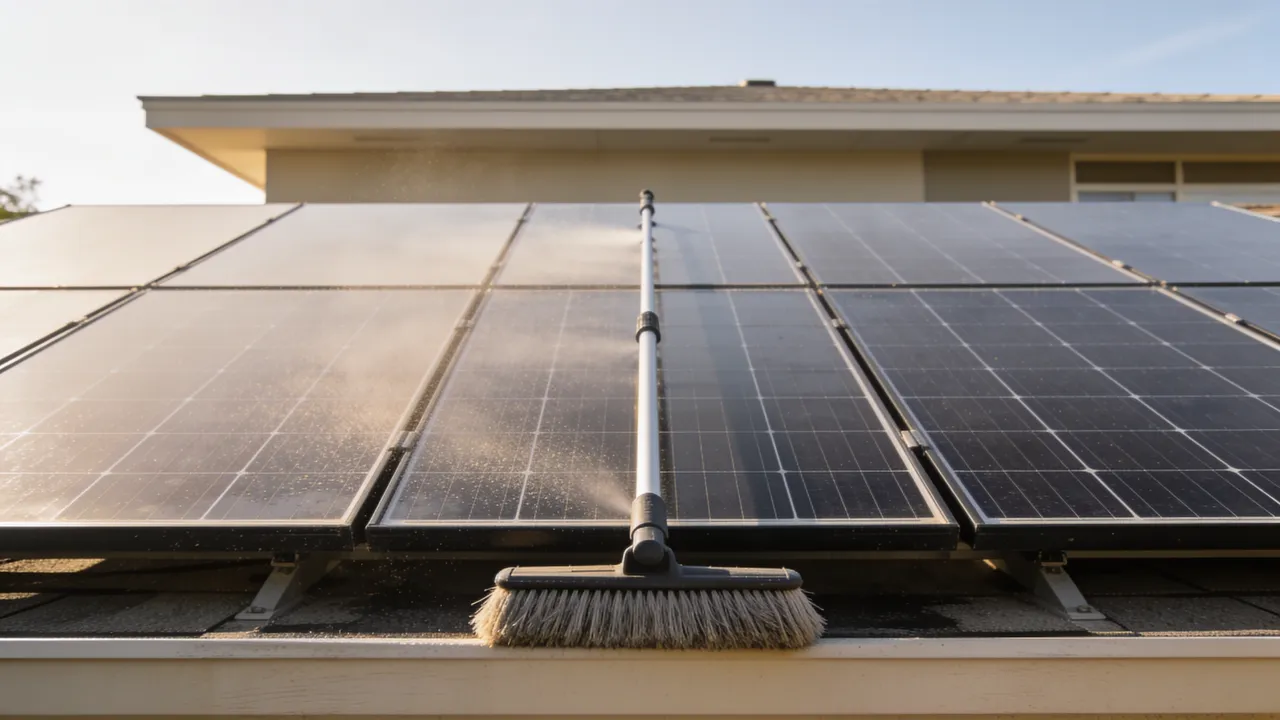
You want to clean your solar panels yourself, and the search results want to sell you a full kit. The honest list is a soft brush on a water-fed pole, plus deionized or distilled water.
What equipment you actually need
Two items do the whole job: a soft-bristle brush on an extendable water-fed pole, and deionized, reverse-osmosis, or distilled water. The brush is soft because a stiff one scratches the anti-reflective coating on the glass. The pole is water-fed so you can reach the panels from the ground and rinse as you loosen. Nothing else earns a place on the list.
The glass is the window light has to pass through to reach the cells behind it, and the U.S. Department of Energy's overview of photovoltaic technology explains that conversion in plain language. A film left on the glass dims what gets through, which is why the water choice matters as much as the brush. The full chemistry is in our post on why deionized water beats tap water for solar cleaning.
What water should you use?
Deionized, reverse-osmosis, or distilled water. Not tap water, and not a garden hose.
East Bay tap water averages around 150 parts per million of dissolved minerals, mostly calcium, magnesium, and silica. East Bay Municipal Utility District publishes its annual water quality data, and the hardness numbers are public. Spray tap water on a warm panel and let it dry in the sun, and the water leaves while the minerals stay. They dry into a thin film that blocks light, the same thing you set out to remove. Concord's hard tap water makes the water choice the single most important item on the DIY list.
Deionized water holds under 10 parts per million of dissolved minerals, so it dries clean. Reverse-osmosis filtered water and store-bought distilled water do the same job. Distilled water runs about $1 a gallon, which is the cheap end of a safe DIY setup.
When is this equipment enough?
A soft brush and the right water cover a narrow, honest case: a ground-mounted array, or a single-story roof with a stable ladder position, carrying only light dust and pollen. No bird droppings, no baked-on soiling.
Bird droppings change the equipment list. They contain uric acid that bonds to the glass, and hosing them spreads the acid across the surface instead of lifting it. If you can see droppings from the ground, skip the DIY and read our post on why rain and a hose do not remove bird droppings.
A two-story roof or a steep pitch moves the equipment list out of shopping territory. The real question at that height is whether you should be on the roof at all. In Danville, where two-story homes with steep-pitch roofs are the norm, the equipment list matters less than the fall risk it cannot fix. The reverse is the honest case for doing it yourself: Lafayette homeowners with ground-mounted systems on sloped backyards are the case where a soft brush and distilled water are actually enough.
What to leave off the list
Three tools should not come near a solar panel. A pressure washer forces water past the panel seals and can crack a cell, and it is the quickest way to void a warranty. A garden hose with tap water deposits minerals as it dries. An abrasive pad or stiff brush scratches the anti-reflective coating. Our post on soft washing versus pressure washing explains the pressure question in detail.
Household cleaners and detergents belong on the same skip list. Manufacturer cleaning guidance calls for water and a soft tool, no chemicals. Clean in the morning or late afternoon, when the glass is cool, so the water does not flash off before you can rinse.
When the kit costs more than a pro
Add up the gear for a single cleaning: a water-fed pole and brush, plus enough distilled or deionized water, plus the time. For a ground mount or an easy single-story roof, that can stay well under the cost of a visit. For a two-story roof, the honest math runs the other way. Residential cleaning runs $175 to $350, and a pro brings the right water, the fall protection, and a crew that does not need to climb on your roof. The fall risk is the line between the two cases, and it is covered in our guide to what is safe to clean yourself and when to call a pro.
If the roof is tall or steep, skip the shopping list and book the visit. Call (833) 444-4173 or request a quote online. You do not need to be home for the work.